Your 4-step guide to AI fluency
By Janice Huang

An office worker opens ChatGPT at 9:14 am.
She types. It answers. She types again.
She clicks off at 9:16 am.
That’s how 95% of AI-using office workers use AI today.
Just recently in January 2026, it was found that most workers only use the bare minimum of their knowledgable companions — ask a question, get a response, and get out.
Isn’t that just googling, but without clicking the blue links?
In the next 2 to 3 years, 55% of all jobs will be automated to some degree by artificial intelligence. But the real shock is this: the gap isn’t between people who use AI and people who don’t. It’s between those who treat it like Google… and those who treat it like a second brain that makes decisions, writes strategies, and does the thinking faster than they ever could.
See how the CEO of NVIDIA puts it in his recent commencement speech at Carnegie Mellon University:
“AI is not likely to replace you, but someone using AI better than you might.”
Jensen Huang
This will be the one AI quote that shuts down your panic about a bot sitting at your desk in your place. To actually use AI effectively, it’s best to have this mindset: You aren’t using AI, you are collaborating with it. AI doesn’t just do the work for you, it does the work with you. This mindset will forever change the way you work with AI.
But that’s only if you follow these 4 simple techniques that Anthropic frames as the 4 D’s: delegation, description, discernment, and diligence. Incorporating these into your collaboration with AI will significantly enhance your workflow and the quality of those AI responses.
1, Delegation
Delegation, or task distribution, is deciding which tasks you do yourself, which you work on with AI, and which you fully assign to AI so everything gets done more efficiently. It also includes turning overwhelming tasks into simple, bite-sized steps. To achieve this, you must first achieve problem awareness and platform awareness.
Problem awareness requires you to understand your goals clearly, and the work that it takes to achieve that goal. Platform awareness, meanwhile, requires your knowledge of what different AI systems can do. With this in mind, before you type the prompt to AI, you must know these three questions deep in your heart:
“What is the overall vision for the task? What does a good result look like?
“What are the different bits of work needed to get there?
Which of these bits of work require human expertise, creativity, or judgment?”
Joseph Feller, Anthropic
Here’s a smart way to make a decision of who does what: you should use your expertise in the tasks you manage, while the AI takes care of the tasks it is good at. Use your knowledge of its capabilities and your capabilities.
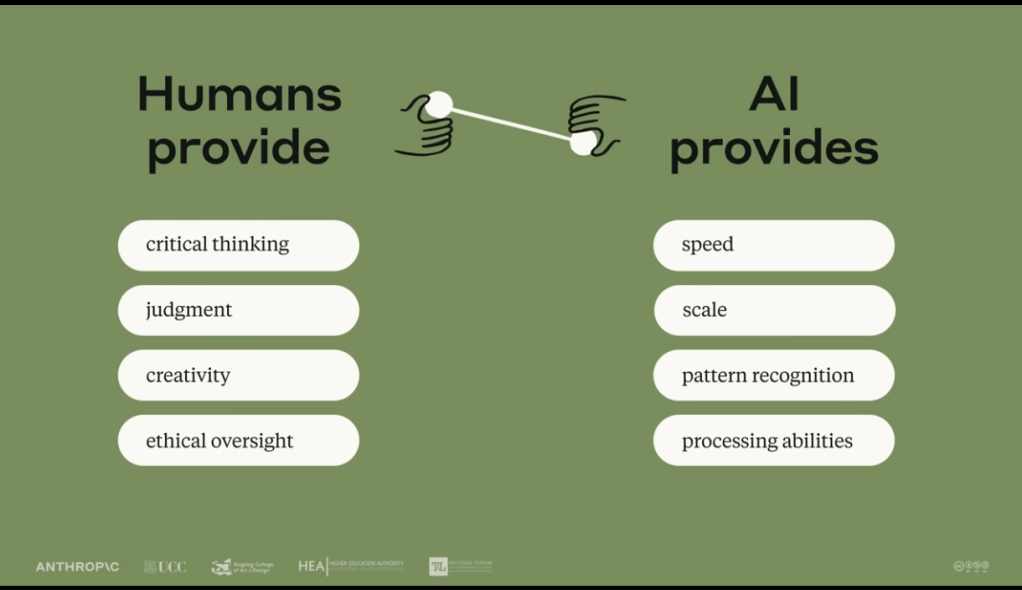
Image from Anthropic Academy: Lesson 3B, Capabilities and limitations, narrated by Rick Dakan
Feller advises you to also chat back and forth with the AI model you are using, as you can discover insights that you previously never thought about before, and the AI can better grasp your ideas and style.
Here is an example of a prompt you can use for delegation:
“I’m working on a writing project about AI and want you to help me improve it without taking over. You should suggest hooks, outline structure, and give feedback on weak or vague ideas, plus offer stronger wording when needed. I will do the actual writing and final decisions. Only rewrite sections if I ask. Focus on clarity, originality, and making my ideas more impactful.”
This is much better than a generic “can you proofread my project” or “is this ok???”
If you deeply understand these three questions before you start your conversation with AI, you are truly mastering delegation.
2, Description
Now that you can manage and distribute tasks among you and your AI, and know each other’s capabilities, you can now learn the second technique: Description.
Instead of just crafting prompts, description tells you to explain the task, ask questions, and guide the interaction. This can be achieved in three ways: product description, process description, and performance description.
Product description is clearly stating what you want the AI to create, and creating a definition of what success looks like. Then, process description involves explaining how the AI should complete the task and what it should do after you click “send”. Subsequently, performance description is how you want it to act while doing it—tone, speed, and style.
“AI tools are not databases or vending machines. They are interactive systems that can behave differently in different contexts much like people might. You need to explain how you want the AI to behave to get the best results. When you next sit down with AI, think first: what kind of thinking partner do you need right now?”
Rick Dakan, Anthropic
Try this example using all product, process, and performance descriptions:
“Product description: Create a short blog post explaining why learning AI is important for students. The post should be 300–400 words and feel engaging, modern, and easy to understand for middle school readers.
Process description: Start with a strong hook, then give three clear reasons why AI skills matter, and finish with a memorable closing line that feels motivating.
Performance description: Write in a viral, high-energy tone like a popular online educator. Keep sentences punchy, slightly playful, and easy to skim. Avoid sounding academic or formal.”
The response you get may instantly exceed your expectations.
3, Discernment
The prior techniques, delegation and description, focused on how you should craft the AI prompt to fit your needs. The third technique, discernment, focuses on how you should evaluate the AI’s output to guide the AI towards success.
Again, there’s product discernment, process discernment, and lastly, performance discernment (ugh, I know, the terms are extremely confusing). Product discernment is checking the final result. Is it correct? Does it make sense? Is it actually useful and relevant to what you asked?
Process discernment is looking under the hood a bit. You’re asking: did the AI reason properly, miss something important, or make a logic mistake while getting to that answer? Performance discernment is about the “personality” side of it, how the AI communicates during the task. Is it clear, confusing, too formal, too messy, or actually helpful for the way you like to work? Is the AI attentive to your specific question?
“Discernment works hand-in-hand with Description in a continuous feedback loop. Even the most advanced AI systems benefit from human judgment and oversight.”
Rick Dakan, Anthropic
Dakan is describing the description-discernment loop: a back-and-forth way of working with AI where you don’t just give instructions once; you describe what you want, then judge what comes out, and keep refining it in a loop until it gets better.
First, description is where you set the direction. You tell the AI what to make, how to approach it, and how it should behave (product, process, performance).
Then, discernment is where you act like a reviewer. You evaluate the output: Did it actually match the goal? (product discernment) Did it reason well or make mistakes? (process discernment) And lastly: Did it communicate in the right style and tone? (performance discernment)
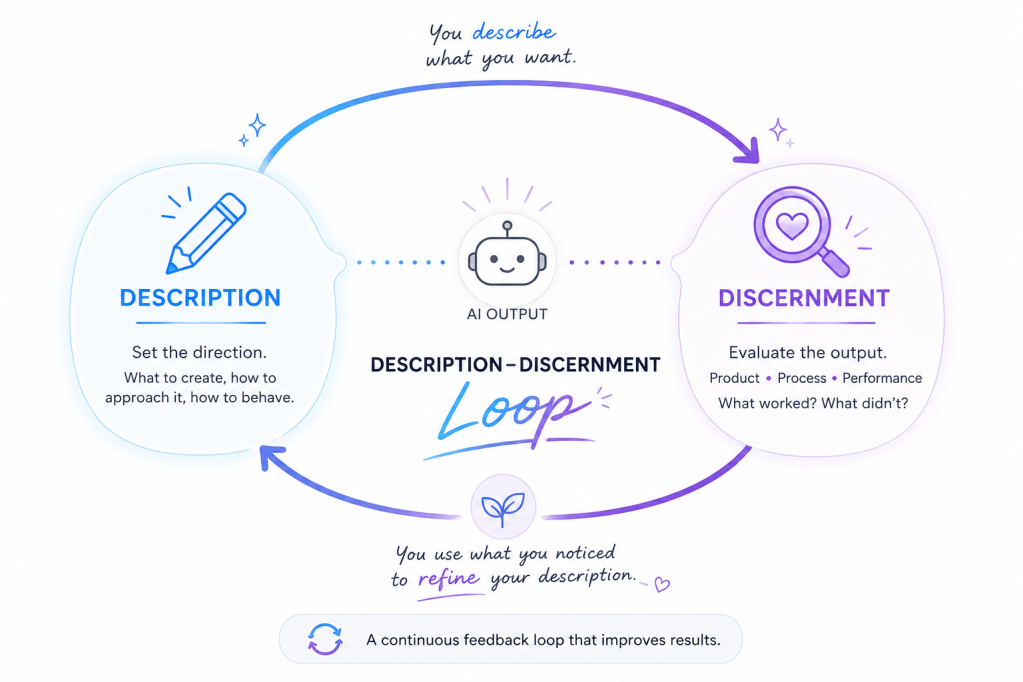
The loop happens when you take what you noticed and feed it back into a better description. So, you’re constantly upgrading the instructions based on what didn’t work, helping the AI fixing flaws on the go.
4, Diligence
You know how to craft prompts. You know how to review them like a boss. Then what on earth is left, then!?
Responsibility.
This is my personal favorite: diligence. To put simply, it’s about owning responsibility for how we work with AI and the impact it has. There are three types of diligence — but at least they’re not product, process, and performance again.
Creation diligence is being intentional about which AI tools we use and how we interact with them in the first place. Transparency diligence means being honest about when and how AI helped in creating something, with the right people who need to know.
Deployment diligence is making sure we double-check, verify, and stand behind anything we use or share that came from AI. Different situations may require different amounts of checking. Overall, thoughtful diligence makes AI use not just faster or easier, but also more responsible, ethical, and safe.
“AI should not only be effective and efficient, but also ethical and safe. Diligence reminds us that our interaction with AI comes with responsibility. We all want AI that is fair, safe, and of benefit to our society. Our own behaviors play a key role in making this happen.”
Joseph Feller, Anthropic
Conclusion
Most people are still typing random questions and hoping for magic. But once you start using the 4 D’s, something shifts. You stop treating AI like a search bar and start treating it like a second brain that actually upgrades your thinking in real time.
Remember, AI isn’t working for you. You are working with AI.
 jan of thought
Your words mean everything to me!!! ❤